Hidden Sector Online is a browser-based space strategy game about holding on to something worth taking. You are handed one planet in a universe full of other commanders, and everything after that is your decision: what to build, who to trust, and when to strike. No download, no client – it runs in the browser on a phone, a tablet or a desktop, and it is free.

It starts with a rock and three resources
Your home world produces alloy, crystal and Helium-3. Alloy and crystal build everything; Helium-3 is fuel, and nothing flies without it. Extractors, synthesizers and skimmers pull those out of the ground, fusion reactors keep the lights on, and habitat domes house the crew who staff it all.
Concretely: an Alloy Extractor costs 2,400 alloy and 600 crystal, and each level draws three units of power while producing alloy round the clock. Every level after that costs about 45% more than the last and produces correspondingly more – so growth is a curve, not a straight line, and the interesting decision is never “should I upgrade” but “which of these four things first”.
Push production without the power or the people to run it and your output quietly throttles back to whatever share you can actually supply. A mine you cannot power is a mine you did not build. You can also deliberately throttle a mine down to spare the grid, which is often smarter than another reactor.
Your colony is a place, not a spreadsheet
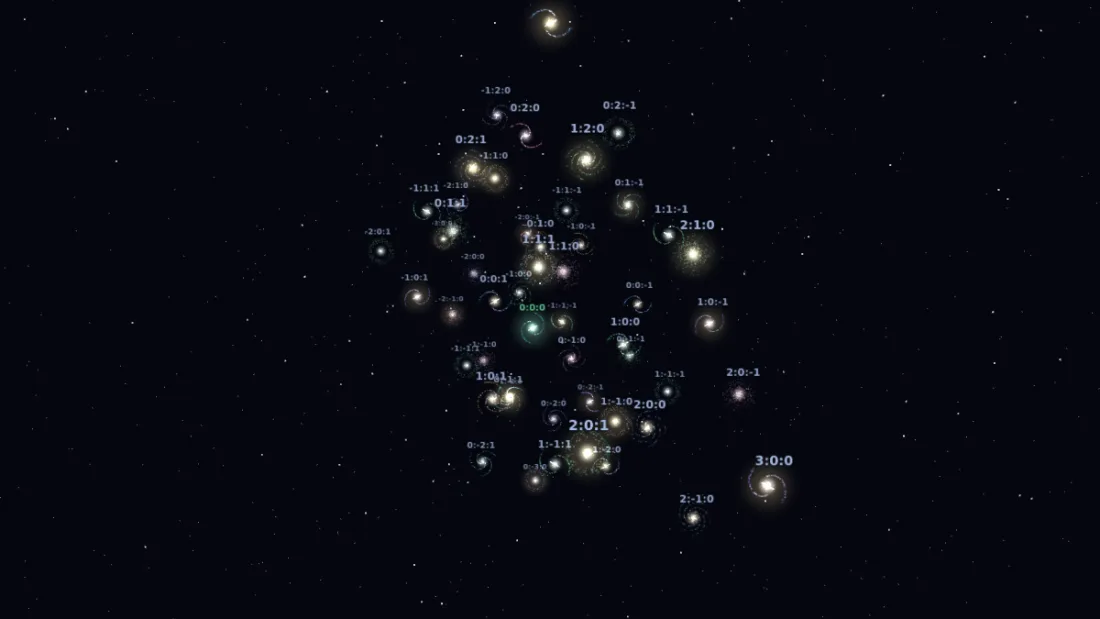
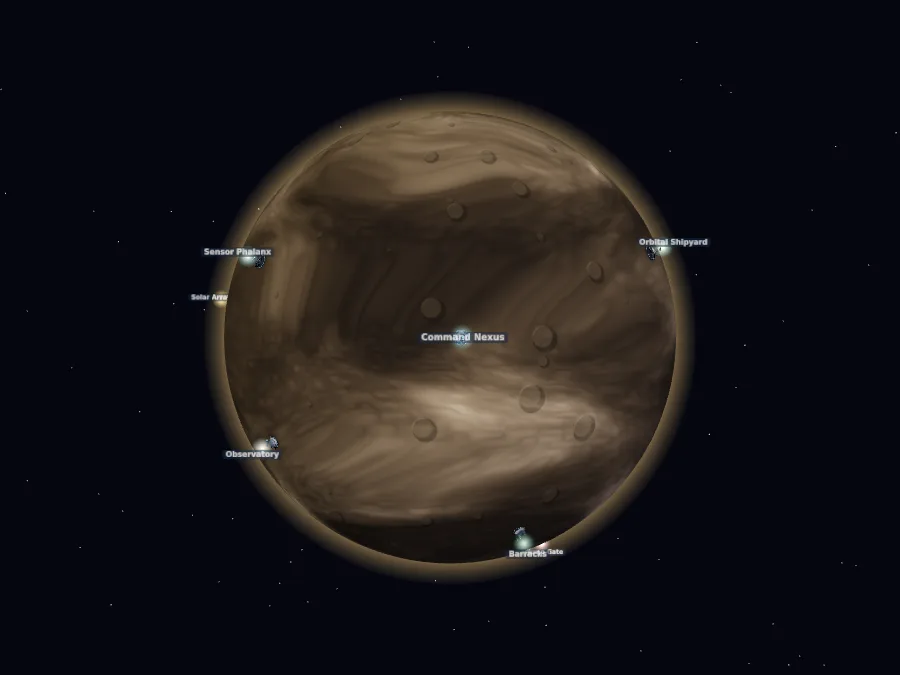
Every world is rendered in 3D and you can turn it in your hands. Buildings physically rise on the surface as you upgrade them, and the sun genuinely sets on them – a structure on the far side sits in the dark until the planet turns. Sectors and the wider universe are 3D maps too, so finding a neighbour means actually looking around rather than reading a table.

Fleets are tools with jobs
Ships are not a single power number. A Probe costs 1,500 alloy and carries nothing at all – it exists to look. A Freighter hauls 36,000 units of cargo and can barely defend itself. A Cruiser hits for 46 and takes 42. A Dreadnought hits for 92 but crawls, and a Colony Ark costs 36,000 alloy and 24,000 crystal to found a single new world.
Two numbers decide how far your reach genuinely extends: fuel and speed. Every hull burns Helium-3 in proportion to the distance, and a fleet travels at the pace of its slowest ship. Each hull also flies on one specific drive – Probes, Corvettes, Interceptors, Freighters and Recyclers on the Combustion Drive; Frigates, Bombers, Landers and Cruisers on the Impulse Drive; Carriers, Dreadnoughts and Colony Arks on the Hyperspace Drive – and only that drive’s research speeds it up. One Dreadnought in a wing of Interceptors holds the whole wing to Hyperspace speed. A fleet that can win a fight it cannot reach is worth nothing.
A raid, step by step
Say a neighbour three sectors away looks rich. First you send a Probe: resource stockpiles always come back, building levels need decent Espionage, and their fleet, defences and garrison only show themselves if you out-spy them. Attacking blind is how fleets die.
The report says they are holding a large stockpile behind a thin garrison. You load Cruisers to win the sky and Freighters to carry the loot – too few freighters and you leave most of it behind, too many and you have paid for holds you did not fill. The fleet burns fuel on the way out, fights on arrival, and flies home with whatever its surviving holds could take.
Before any of it you can run the whole thing through the in-game battle simulator: your hulls against what you think they have, and it reports the verdict, the losses on both sides in ships and in resources, and the wreck field the fight would leave. It runs the same arithmetic the real battle does, so the projection is exact. What it cannot know is what they actually have – that is what the Probe was for.
Afterwards the report gives you the whole line of battle rather than a total: a table per side, a row per hull type, showing what stood in the line when the shooting started, what survived, what it cost, and how many of that hull were still standing at the end of every one of the six rounds. It is the difference between knowing you lost eight bombers and knowing they died in the second round, before they ever reached the wall.
Wreckage, and the moons that come out of it
Every battle leaves debris in orbit, and debris is real metal: send Recyclers and it comes home. A ring hanging over a world is an invitation, and defending your own wreckage is as much a decision as making somebody else’s.
Very occasionally an enormous battle collapses its own wreckage into a moon, there and then. It takes at least 900,000 units of wreck before it is even possible, and even then the chance runs from 1% up to a ceiling of 6% – so a moon is a story, not a plan.

A moon mines nothing – it has no atmosphere, no crew and no economy – but it makes a superb forward base. It runs on solar arrays instead of reactors, and it is the only place you can build two things. A Sensor Phalanx is the counterpart of espionage: a probe tells you what is parked on a planet, a phalanx tells you what is moving, listing every fleet going to or from any world in its reach. A Jump Gate is built once and never upgraded, costs a fortune and drinks power – and halves the travel time between two moons that both have one.
Taking a world is not the same as raiding one
A raid wins resources. Conquest is a different thing: you research the doctrine, win in orbit, land marines to break the garrison, and then hold the planet under siege long enough to land a Colony Ark. Sieges can be broken – the defender, or their allies, can come and take the sky back, and a relief force that outguns the occupation clears it in one strike.
Alliances, and what they actually do
Alliances are the social spine of the game. Members cannot raid one another and they share what they know: recon and battle reports can be published to the whole alliance, so intel one scout paid for protects everybody. There is private chat, a categorised forum, and a mentoring system that rewards experienced players for bringing newcomers up to speed.
They also pool resources. Anyone can send goods into the alliance depot; the leadership decides what to spend them on. Shared Foundries lift every member’s production by 3% per level; Fleet Logistics cuts 4% off everyone’s build times. A funded project lifts the whole alliance at once, which is what makes pooling worth more than standing next to each other.
And they fly together. Open an attack as a joint strike and your allies can fall in with it: they inherit your target and, crucially, your moment of arrival, so every wing lands at once and the defence faces one battle instead of a queue of separate raids it can beat piecemeal. The reward is shared by what each wing staked – commit the fleet you have and you earn it in full, however small that fleet is, which is how a young commander flying beside veterans climbs faster than raiding alone could manage.
Fair fights are enforced, not requested
Large empires cannot farm small ones. Newcomers sit behind a beginner shield – which lasts until their own score passes the realm’s beginner mark rather than for a set number of days, so a slow start is not punished – raids are held inside a size band, and hitting the same world twice in one day pays half. Dishonourable raiding drains your reputation and pays it to your victim – and a joint strike is judged on the whole formation, so ganging up on somebody you collectively outclass dishonours every wing in it. Push it far enough and the galaxy’s hardest AI starts hunting you specifically.
There is also a holiday mode. Freeze your empire and step out of reach: nothing is produced, nothing can be built or flown, and nobody can raid you. You can only leave from a quiet position – nothing inbound, nothing in flight, nothing under construction – so it is a holiday and not a shield.
Realms, and how a game ends
The universe is not one shared server but several parallel realms, each with its own commanders, worlds and alliances, and each running at its own speed. You may hold one commander in each, and holding several is not multi-accounting: the rule against that is about two of your commanders meeting in one universe, and yours never can.
A realm has an ending, and nobody is told the date – not the players, not the operators. What you get is warning: three times as the moment approaches the whole realm hears the same thing, first that deep-range instruments have picked up a tremor nobody can place, then that it is growing, and last that the sky is bending.
Then a sector that has stood empty since the realm was founded fills with seven gas giants – worlds that exist nowhere else, mine nothing, and take no structure but a methane extractor, so everything that goes into one is flown in by convoy. This is the Hidden Sector. Alliances settle the giants, wind the extractors up, and fight each other for the ground, and a giant changes hands with every extractor level its last holder paid for, which makes a nearly finished one the most valuable thing in the realm.
When every giant reaches its breaking point the sector goes up all at once, and it is total: every giant, every colony standing on one, every building, every unit ever flown there and every fleet still in orbit. No salvage, no debris field. Whatever you sent into the Hidden Sector, you sent to stay. The alliance holding the most worlds at that moment wins the realm and is written into the hall of fame – worlds held, not charge poured in, so a giant lost the day before is worth nothing to you and everything to whoever took it. A sector can also go up with nobody holding a world in it, and then the realm is simply over with no victor.
What is left is the sector’s own star, collapsed into a black hole. That is the portal, and it answers to the winning alliance alone – not to the realm, and not to everybody who happened to be in it. It leads nowhere until a second realm finishes its own Hidden Sector; then the two dimensions bridge and each side’s holders can cross to raid, scout and supply. Two realms bridge only when the build, production and research speeds they are set to are identical, so cross-realm war stays fair – what a realm happens to be running at on the night does not count, because weather is not tuning. The portal is the endgame; travelling between realms is the aftermath.
What it costs
Nothing. Anything purchasable is cosmetic or convenience – ring colours, interface accents, and the Fleet Commander subscription’s empire-wide overview. None of it makes your guns hit harder, and none of it is needed to win a realm.
Pick a world. Build something worth defending. See how long you can hold it.